Back to rest
How the machines are looked after
A reformer is only as good as the last check it had. The studio intends to keep every machine on a written cycle of looks, cleans and part changes, and to take a machine off the floor the moment something is wrong with it.
The intervals below are maker guidance, quoted from the maintenance a reformer maker publishes for its own machines. Each machine’s own manual comes first wherever it says something different.
A cycle that lengthens along the rail
Four intervals, from the look a machine gets every morning to the part it gives up every two years.
Every day
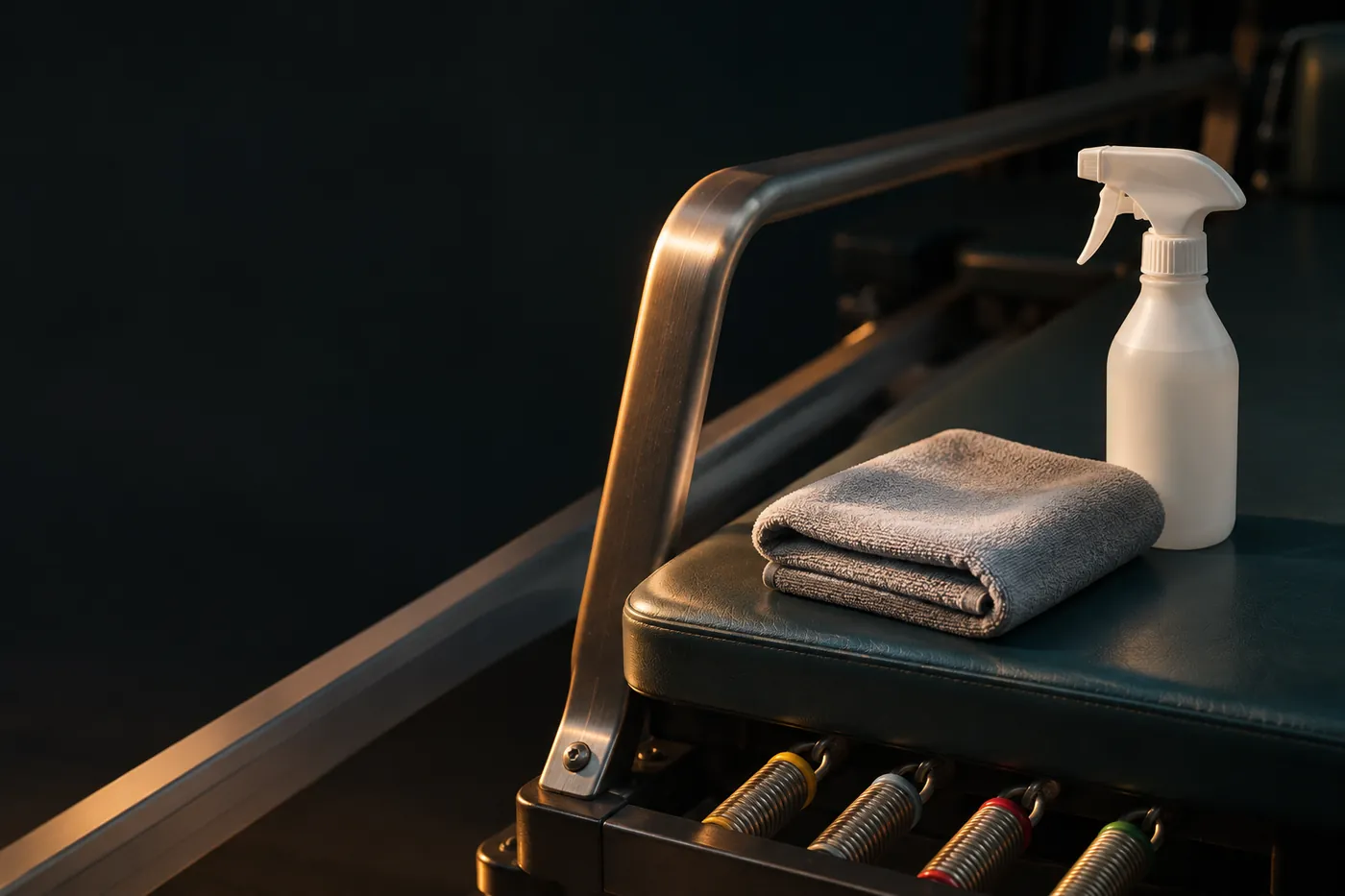
A visual look-over of frame, rails, carriage, springs and ropes before the first class. The footbar is moved through its positions and must hold each one and pivot with resistance, never drop freely. After use the vinyl is wiped with a mild solution that contains no silicone, then with a cloth dampened in plain water, and dried.
Every two months
A thorough inspection of all hardware: every nut, bolt and fastener on the frame, footbar, risers and carriage checked and tightened where it needs it. The rails are cleaned as needed with mild soap in warm water and dried with a soft cloth.
Every two to three months
The carriage wheel axles are inspected. Debris caught between a wheel and its housing is removed, and an axle is tightened if the wheel shows any play. The sealed bearings need no attention of their own.
Every two years
Each spring is replaced, whatever it looks like. The springs have a rule of their own below.
- Every two years
- Each spring is replaced, whatever it looks like.
- At the first coil gap
- Any spring showing separation between its coils, even slight, is replaced at once.
- Every machine
- Spring changes are written down by machine and position, so each spring’s age is always known.
Springs
Springs carry the work of every class, so they are the part with the firmest cycle. Replacement follows the same rule on every machine regardless of colour, because a spring’s colour says which rung it is, not how old it is.
Ropes, straps and loops
Some fraying on a rope is normal wear. A rope with heavy fraying, a tear or any other fault is replaced straight away. Leather straps are given leather conditioner when they need it so they do not dry and crack, and straps that stretch unevenly are adjusted on their holes.
Safety clips wear over time and are replaced as needed.
Out of service, and the reset
A machine with a fault is tagged out of service and taken off the floor until it is fixed. A class is planned around the machines that are ready, never around one that is waiting for a part.
After every class each machine is reset to the studio’s resting state: springs to the agreed setting, footbar and headrest to neutral, straps on their hooks, and the carriage home against its stopper. Back to rest, ready for the next stroke.